Did You Know?
Check out these cool facts about Germantown History! We’ll keep the ball rolling and will update the page periodically. Have any leads? Let us know on the contact page!
Brief Bank Building History
The Germantown Bank Corporation was formed by community leaders (Andrew Baker, William Waters, Norman A. Waters, Henry Clyde Pumphrey, Augustus Selby) in 1922. Shares in the Bank were sold to local people and it operated more like todays credit unions with the objective of serving the customers and the community. John A. Stover was the first bank manager. He lived in Germantown and knew all of the customers personally. Customers included African Americans and women as well as the wealthy. It served the community well for more than 60 years and never closed during the great Depression. The Germantown Bank became the Suburban Bank in 1960, with Lewis Wood as manager. The building was given to the County in 1983, and to the Germantown Historical Society in 2015.
How did we get the name GERMANTOWN?
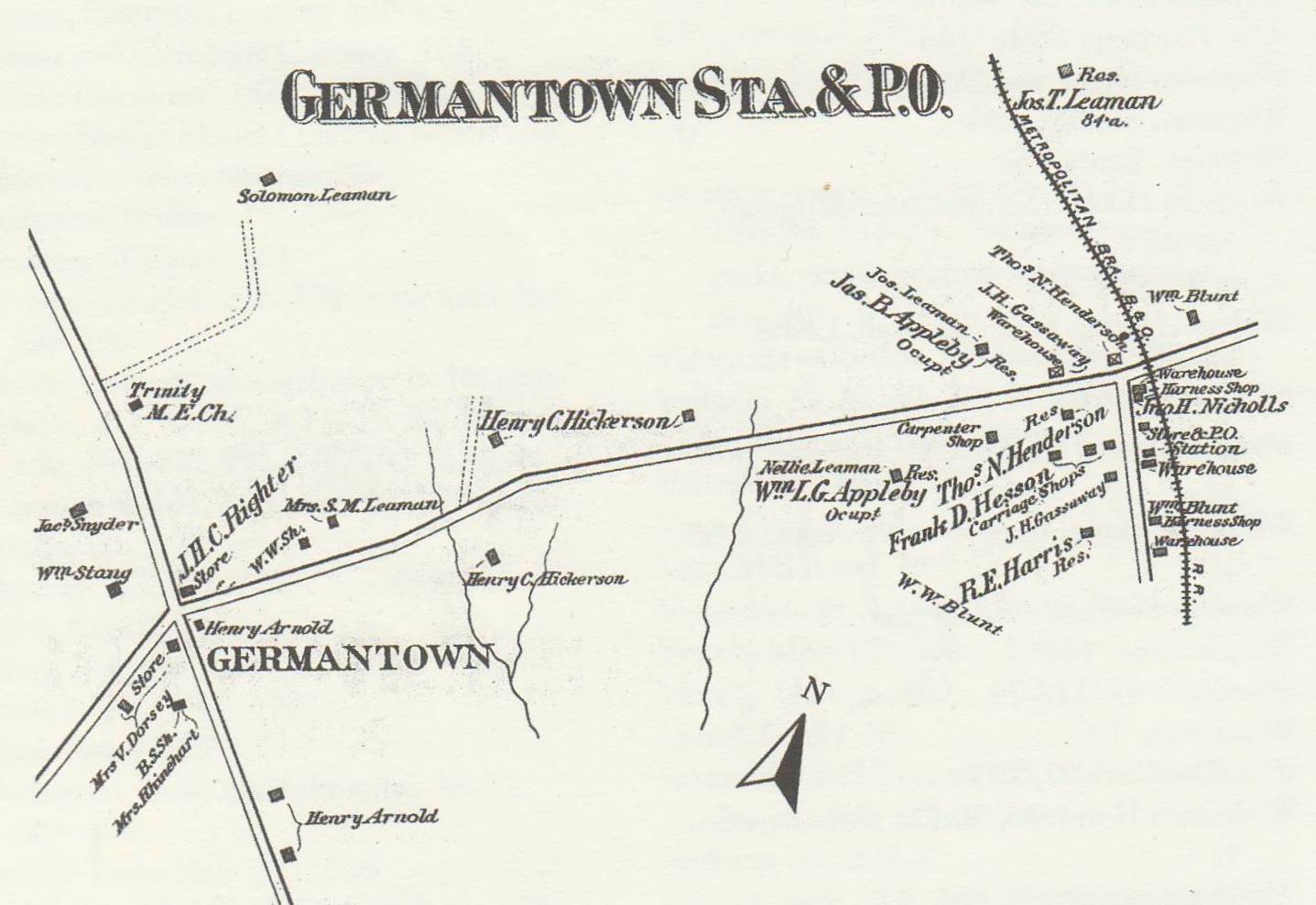
Germantown began as a crossroads town. The Georgetown/Frederick Road (Rt. 355) was based on an old Indian trail and became the main northwest route from Georgetown in the 1740s. Neelsville was one of the towns that formed along this road. A branch of this road, Rockville/Darnestown Road (Rt. 28) appeared in the late 1700s. McCubbin Mill Road (now Clopper Road) was constructed by the state of Maryland in 1805 to connect Logtown (Gaithersburg) to Barnesville.
The Neelsville Presbyerian Church on Rt. 355 and the Darnestown Presbyerian Church on Rt. 28 were served by the same minister, who had a very circuitous route to travel between his parishes. In the early 1840s, members of the two churches, along with local farmers, constructed a road to connect Neelsville and Darnestown — now called Germantown Road (Rt. 118) and Liberty Mill Road. Where this road crossed Clopper Road Prussian and Austrian tradesmen, many recent immigrants, set up shops to serve the local farmers, mainly of English descent.
The word “German” was coined by Julius Caesar as “Germania” to refer to all of the people east of the Rhine. In the 10th century “German” territories made up the central part of the Holy Roman Empire. Germany did not officially form as a nation until 1871. So, the calling of this crossroads “Germantown” meant that these were immigrants from central Europe sharing a gutteral-sounding language.
“Take Me Home, Country Roads”
The song “Take Me Home, Country Roads” made popular by John Denver in the 1970s was inspired by our very own Clopper Road. Singer/songwriters Taffy Nivert and Bill Danoff (Fat City) were driving to a family reunion along Clopper Road in the fall of 1970 and to pass the time, they made up a song about winding roads in the country. Denver met up with them in December after Danoff and Nivert opened for him at the Cellar Door in Georgetown, and they stayed up all night re-writing and re-arranging the song. John Denver first sang the song at the Cellar Door on December 30, 1970 and received a standing ovation. He then went on to record “Take Me Home, Country Roads” on the album “Poems, Prayers & Promises” that came out in the spring of 1971 — and the rest is history.