Historic Figures
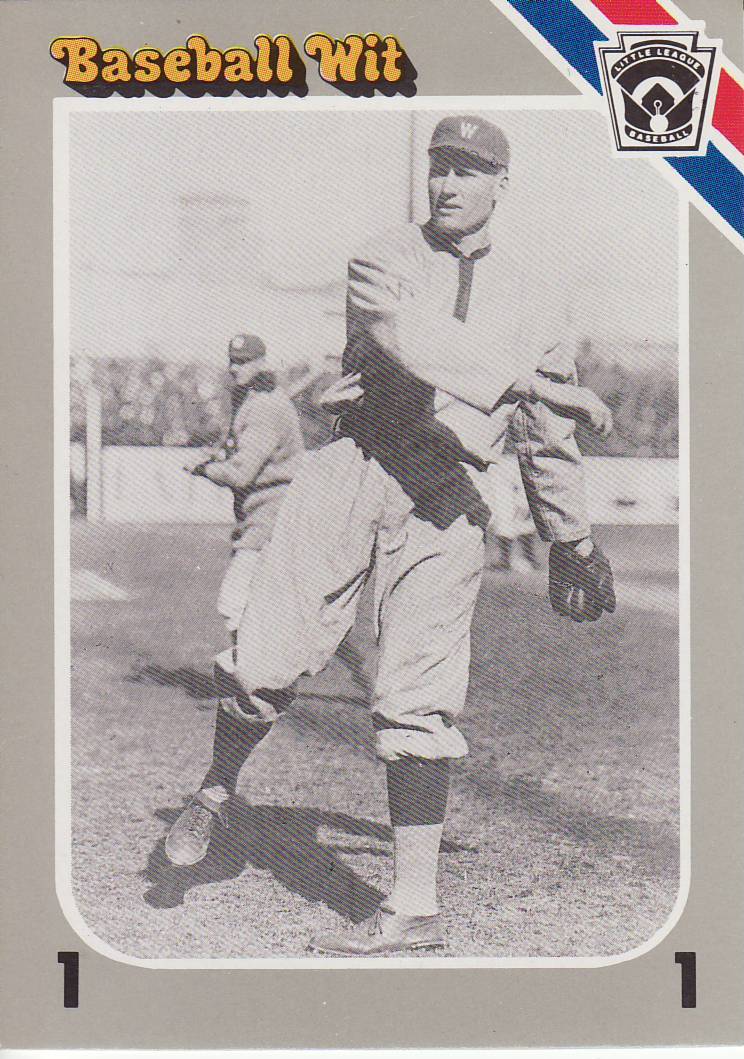
Walter Perry Johnson
One of the first five players inducted into the Baseball Hall of Fame, Walter Perry Johnson, nicknamed “Big Train,” was a pitcher for the Washington Senators from 1907-1927, including their World Series win in 1924. In 1935 he purchased a 550-acre dairy farm in Germantown where Seneca Valley High School is today. He was elected to the Montgomery County Board of Commissioners. He died in 1946.
The Waters Family of Germantown
The Waters family is the oldest family of European descent in Germantown. They first came to this area in the 1780s and owned most of the land east of the railroad, north of Rt. 118, and south of Little Seneca Creek in present-day Germantown. Three brothers — Zachariah, William, and Basil — were given the land by their father, William Waters of Belmont.
This William Waters was the son of Samuel Waters of Anne Arundel County, who was the son of John Waters who had emigrated from England in 1669. He was born in 1716 at “Jericho” in Prince George’s County. William Waters acquired land in Prince George’s County, where the town of Brookeville is today, near Olney. He became very prosperous and over the years bought much more land, with several land patents, in what is now Montgomery County. He built a lovely mansion on his estate in Brookeville in 1747 (destroyed in the 1930s), which was called “Belmont.” In 1747 he married Mary Harris, daughter of Thomas and Sarah Offutt Harris of St. Mary’s County.
William and Mary Waters had eight children at Belmont: Zachariah, William, Sarah (Holland), Anna, Basil, Nancy (White), Eleanor, and Ignatius. William, Sr. died in 1788. He had already given Zachariah and William their portions of land. His will divided the remaining land between Basil and Ignatius, with Ignatius receiving the home estate at Belmont.
In Germantown, Zachariah’s farm was known as “Poplar Spring,” William’s farm was “Water’s Place,” and Basil’s farm was “Pleasant Fields.” All three properties came mainly from the original land grants “Conclusion,” “Sierra’s Love,” “William and Mary,” and “Ralfo.” “Panther’s Ridge” and “Poplar Spring” were consolidated into Conclusion. Each of the brothers built a substantial house near branches of Little Seneca Creek. Zachariah married Anna Baker and they had three children: Tilghman, Baker, and Courtney. William married Susannah Magruder and they had three children: Nathaniel, Horace, and Guilemaria. Basil Waters married Anne Pottinger Magruder and they had three children who survived to adulthood: William, Zachariah, and Zadock.
Although the children of Zachariah never had any children, there are many descendants of Wiliam, Jr., Basil, and Ignatius Waters currently living in the county. Surnames include: Berry, Butler, Byrd, Christie, Davis, Dorsey, Etchison, Ficken, French, Gibson, Gochenour, Griffith, Hilleary, Hockman, Holland, Jacobs, Jones, Lumpkin, Milliken, Pumphrey, Riggs, Sheffenacker, Spates, Sprinkle, Sydnor, Thrift, Waters, White, Wood.
References
- ”Anne Arundel Gentry”, Harry Wright Newman, 1971
- ”Waters Book”, Edith Worley Beatty
- “Waters House” Peg Coleman, ”Montgomery Courier”, Nov. 11, 1981
- “Roots for a New Neighborhood,” Margaret Coleman
- Memoirs of Maria Waters
- Landmarks research: “William Waters House;” “Pleasant Fields;” “Graveyard on the William A. Waters Farm”
Revolutionary War Patriots
Basil Waters, son of William Waters, Sr. — 2nd corporal, 4th Co., Middle Battalion, Maryland militia, July 15, 1780
William Waters — private, 2nd Co., Middle Battalion, Maryland militia, September 4, 1778
Reference: Peden, Jr., Henry C. (Bel Air, MD), Revolutionary Patriots of Montgomery County, Maryland, 1776-1783. 1996.
Zachariah Waters probably moved to what is now Germantown before 1778, because on March 7 of that year he was commissioned as a Justice of the Peace and appointed to raise $1,333.00 in Sugarloaf Hundred for the County’s quota for arms and ammunition for the Continental Army for the Revolution.
Reference: Newman, Henry Wright, Anne Arundel Gentry, p. 423.
William Waters (Jr.)
Enlisted: 10 October 1776, private, 12th regiment
Enlisted: June 1777, private, 2nd regiment
Nicholas Seybert (owned what was later Clopper Mill and lived in a house on the north side of Seneca Creek)
Enlisted: 27 August 1778, Lieutenant, 7th regiment, Maryland
Benjamin Spyker (purchased mill from Seybert after the War
Enlisted: 1 January 1777, captain, 7th regiment, Maryland
Reference: “U.S. Compiled Revolutionary War Military Service Records”
Francis Cassatt Clopper
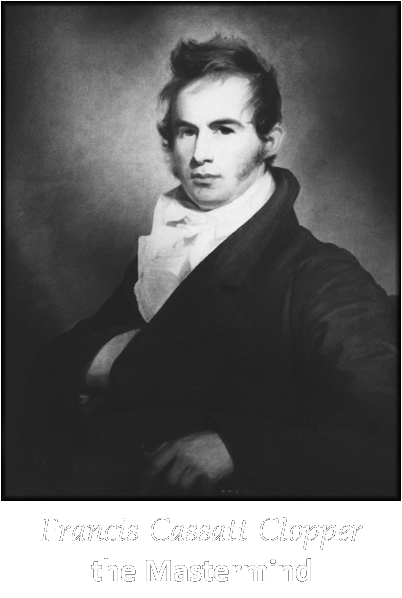
Francis Cassatt Clopper was born in 1786 and had been a merchant in Philadelphia. He was a distant relative of the artist Mary Cassatt. He moved to Germantown in 1812 to a farm he had created out of several properties. He named his new farm Woodlands and added to the original log cabin creating a grand Victorian house. He renovated a grist mill and a woolen mill on Seneca Creek which ran through the farm. Clopper gave land for the St. Rose of Lima Catholic Church on behalf of his wife, Anne Byrne Clopper, who was Catholic. It is named for one of their daughters who became a nun. Bricks for the church were made on his plantation. He was instrumental in creating the railroad that runs through Montgomery County. He also forced enslaved people to labor on the plantation, as was noted by Frederick Law Olmstead in A Journey in the Seaboard Slave States (pp. 6-13). Francis C. Clopper died in 1868. The entire farm was purchased by the State of Maryland in 1955 for Seneca Creek State Park. Descendants lived in the house until 1965 and the vacant house was burned down by arson in 1967.
Look at: Description on the Seneca State Park website
Description of the historic markers on the site
George Atzerodt: The Lincoln Assassination Connection
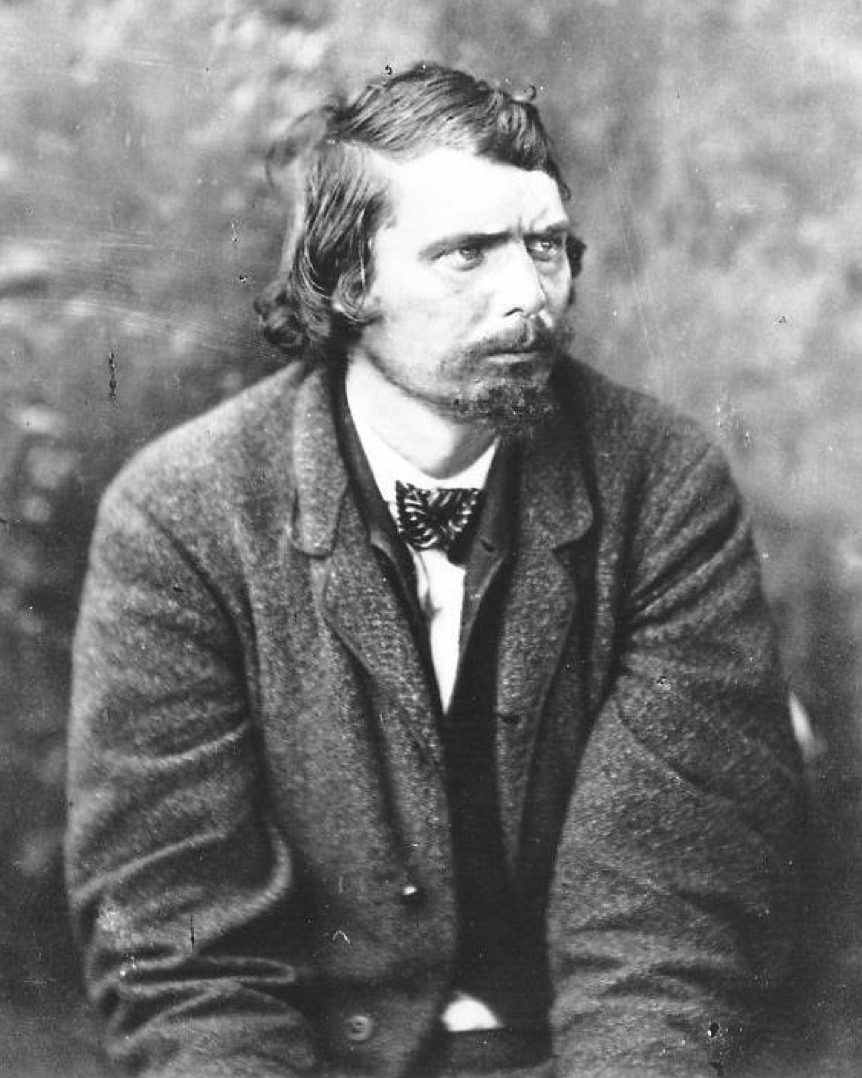
Photo Credit: Library of Congress
Many of you who have seen the recent movie The Conspirator will know that George Andrew Atzerodt (alias Andrew Atwood), was one of the Lincoln assassination conspirators executed on July 7, 1865. Atzerodt was arrested in Germantown, Maryland, the town where he had spent many years as a boy. How he got involved with the Booth gang and why he ended up back in Germantown is a compelling story.
This story begins in 1844 when George, age nine, arrives in Germantown with his family, immigrants from Prussia. George’s father, Henry Atzerodt, purchased land with his brother-in-law, Johann Richter, and together they built a house on Schaeffer Road. In the mid-1850s Henry sold his interest in the farm and moved to Westmoreland County, Virginia where he operated a blacksmith shop until his untimely death around 1858. At this time George and his brother John opened a carriage repair and painting business in Port Tobacco, Maryland.
After the Civil War broke out the carriage painting business was not doing well, so John went up to Baltimore and got employment as a detective with the State Provost Marshal’s office. George stayed on at Port Tobacco but his main business was not painting carriages, it was blockade running and smuggling across the Potomac River.
It was on one of these clandestine trips that he met John Surratt, son of Mary Surratt, who was acting as a courier for Confederate mail. In November 1864 Surratt convinced Atzerodt to join the group, led by John Wilkes Booth, planning to capture President Lincoln, take him to the South and hold him for ransom. Since they planned to take their hostage through Southern Maryland and across the Potomac River, Atzerodt’s knowledge of the land and the river was indispensible.
Surratt took him to Washington where he met John Wilkes Booth and other conspirators. One plot to kidnap Lincoln on his way to the Veterans Hospital on March 17, 1865 failed when the President changed his plans at the last moment. The surrender of General Lee, however, had convinced Booth that more drastic measures were needed. The plan he presented at around 7pm on the night of the assassination was to immobilize the federal government by removing the top three heads. Booth would assassinate Lincoln, Lewis Powell would take care of the Secretary of State William Seward, and Atzerodt’s assignment was to kill Vice-president Andrew Johnson.
Atzerodt’s courage evaporated when the time came, however, and he spent the evening drinking and wandering around Washington. In his confession he would claim that he never intended to kill the Vice-President and that he threw away the knife and pawned the gun that were given to him. Yet he did accept the knife and gun, and he did not turn in the other conspirators when he knew that the plan had changed from kidnapping to murder. These two things were what convinced the Military Commission that he should be executed.
After he heard that Booth had actually carried out his part in the plot, George decided that he should leave Washington as soon as possible, and not in the direction of his home in Port Tobacco since that is where he knew Booth had gone. He would go to a place where he had friends and family, where they would welcome him without questions – his old home in Germantown. The following morning he managed to get through the blockade around Washington by buying the guards a few drinks. Then, catching a ride with William Gaither, he made his way to Gaithersburg and, after stopping for a drink at Mullican’s tavern, he proceeded on foot toward Germantown on the Barnesville Road (now Clopper Road). It was very late when he crossed the wooden bridge over Seneca Creek and saw a light in the Clopper Mill. He asked the miller, Robert Kinder, if he could stay the night, and Kinder, who knew George from his previous visits to the area, showed him hospitality (for which he would later receive six weeks in jail).
In the morning George started on his way to his cousin, Hartman Richter’s house just two miles away. He was very hungry, though, and, it being Easter Sunday, he decided to stop at the Metz home which was on his way. The family invited him to stay for dinner. The Leaman brothers, Somerset and James, were also visiting the Metz family. Of course, the assassination was the topic of conversation of the day, and George must have let a few things slip to arouse the suspicion of the Leaman brothers who later testified against him. A neighbor, Nathan Page, was also at the Metz’s that day.
After dinner George cut across the field to drop in on his cousin Hartman Richter, son of Johann. Knowing nothing of George’s part in the assassination conspiracy, the Richters took him in and gave him a job on the farm. For the next three days George did odd jobs at the Richter farm. On April 19th he was sound asleep in an upstairs bedroom of the house when he was rudely awakened about 5 a.m. by soldiers, one of whom was pointing a revolver at his head. He was quickly arrested and taken to Washington.
The soldiers, stationed in Clarksburg, had been alerted of a “suspicious character just up from Washington” by a tip from one of their local informants James Purdom. Purdom had run into Nathan Page earlier and Page had told him about George and what he had said at the Metz home. Purdom and Page would end up splitting the $25,000 reward for the capture of Atzerodt. George was a goner anyway, though, for just a few hours after he was arrested another group of soldiers arrived at the Richter home looking for him, this second posse had been sent by the Provost Marshal after receiving information from George’s brother, John.
Hartman Richter, the Leaman brothers, as well as the old miller, were also arrested and imprisoned on a prison ship in Washington until the trial, after which they were released. George Atzerodt was tried and convicted by a military court. He was hanged in the yard of the Arsenal in Washington D.C. along with Lewis Powell, David Herold and Mary Surratt on July 7, 1865.
The ruins of the Clopper Mill can be seen on the west side of Clopper Road just to the north of Seneca Creek opposite Waring Station Road. The home of Hartman Richter on Schaeffer Road in Germantown accidently burned down in 1982.
Much of the information on George Atzerodt’s arrest came from the book, Blood on the Moon: The Assassination of Abraham Lincoln by Edward Steers.